
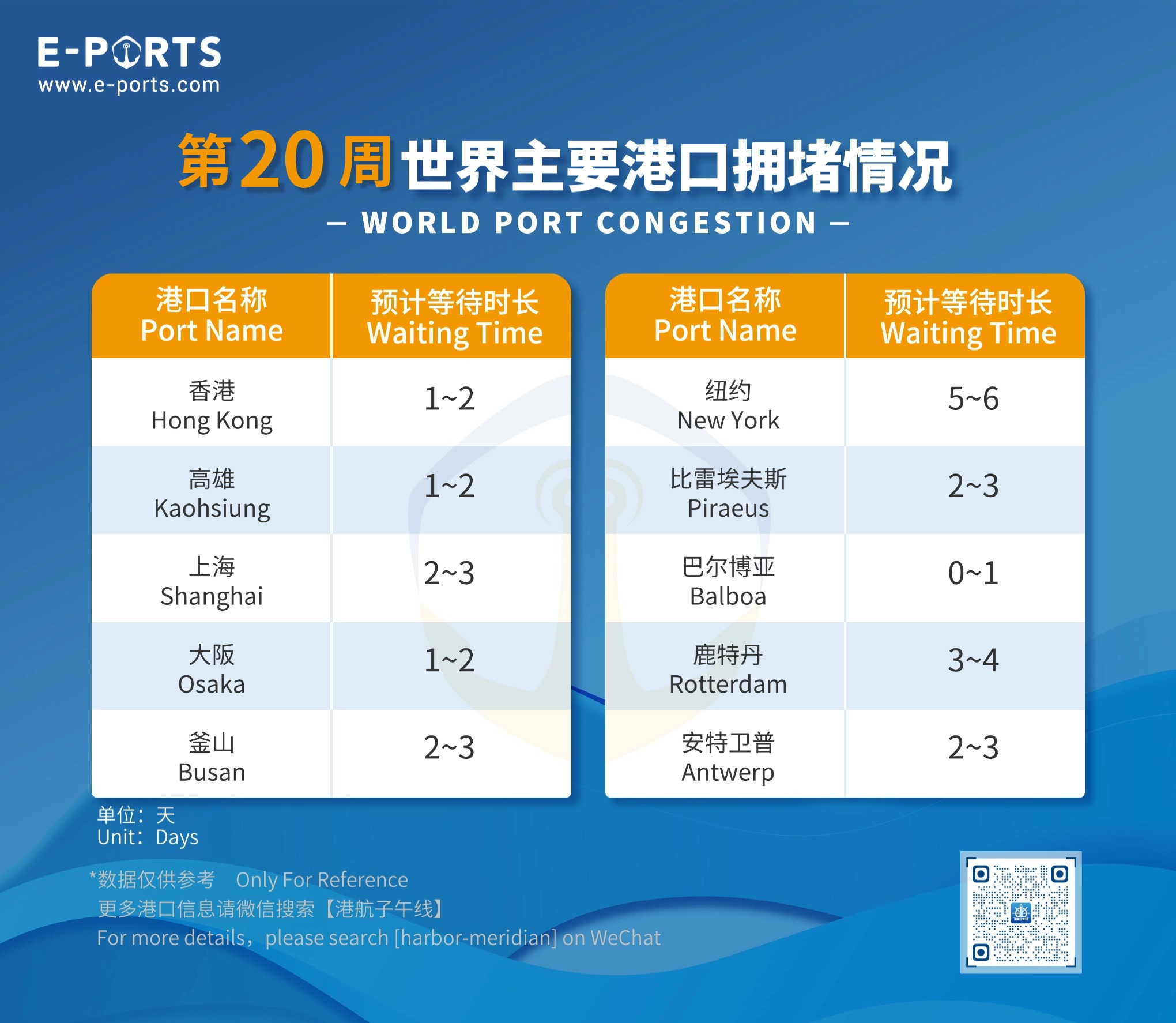
Port Congestion | Week 20 Line-Up: Panama Canal Delays May Worsen as Brazil’s 32 Major Ports Face Imminent Strike港口拥堵 | 20 周 line-up 巴拿马运河恐将放大拥堵 巴西32大港口罢工在即
Panama Canal Enters June Maintenance Window
巴拿马运河进入六月维护窗口
Congestion at the Panama Canal intensified further in mid-May. According to data from Nordic investment bank SEB, average waiting times at the canal have now reached 47.9 hours — roughly 60% higher than the average levels seen during the pre-crisis period in January and February.
SEB noted that congestion pressure has been steadily building, while planned lock maintenance scheduled from June 9 to June 17 could worsen delays further. Some vessels may be forced to remain at anchorage for extended periods, while others could choose longer alternative routes to avoid queuing risks.
Canal authorities, however, stated that even if El Niño conditions and potential drought risks emerge in the second half of the year, no additional transit restrictions are currently planned for the remainder of 2026.
The Panama Canal Authority also emphasized that water conservation measures implemented since last year have helped maintain Gatun Lake water levels at relatively high historical levels.
巴拿马运河拥堵在5月中旬进一步加剧。北欧投资银行SEB数据显示,目前运河平均等待时间已达到47.9小时,较战前1月至2月期间的平均水平高出约60%。
据SEB分析,拥堵已经在持续积聚,而计划于6月9日至17日进行的船闸维护将可能引发拥堵进一步恶化,造成部分船舶被迫滞留,其余船舶可能选择绕行以避免排队风险。官方则表态,即使下半年出现厄尔尼诺天气和潜在干旱风险,2026年剩余时间不会采取通行限制。运河管理局也指出自去年以来实施的水资源保护措施已使加通湖水位保持在相对较高的历史水平。
South America: Strike Threat Across 32 Brazilian Ports as Santos Waiting Time Nears Five Days
南美:巴西32大港口罢工在即,桑托斯等泊近5天
Brazilian ports are facing mounting operational pressure that could soon intensify further.
Brazil’s port stevedore unions (Estiva) together with temporary labor unions have announced a nationwide 12-hour strike scheduled for May 20, involving 32 major ports including Santos, Rio Grande, and Fortaleza.
The core dispute centers on protecting exclusive hiring rights for port labor workers. As of the eve of the strike, negotiations between stakeholders had still failed to produce a consensus.
The strike threat comes at a time when Brazilian ports are already operating under heavy strain:
- Santos Port is experiencing average waiting times of around 116 hours (nearly five days), while container yards are approaching saturation.
- Vila do Conde Port has recorded waiting times of up to 242 hours (more than 10 days), setting a new local record.
- At Porto Velho, more than 1,200 trucks are reportedly queued, while soybean export delays have already exceeded six days, affecting global shipping schedules.
According to Hapag-Lloyd’s Latin America operational update released on May 5, Santos Port yard utilization has reached approximately 72%. However, congestion inside navigation channels and increasingly complex vessel scheduling have significantly prolonged waiting times. In some areas, berth delays have stretched to 10 days or even longer.
The strike is expected to disrupt cargo handling, customs clearance, and landside logistics operations. Shipment delays on Latin America–Asia and Latin America–Europe trade lanes are likely to worsen in the days following the labor action.
Meanwhile, Argentine ports are still dealing with the aftereffects of landside strikes that began in April. Although access blockades at Bahía Blanca and Quequén have now been lifted, negotiations over trucking rates remain ongoing. Risks of additional labor disruptions at ports such as Rio de Janeiro also continue to linger.
巴西港口正遭遇严重且即将进一步加剧的压力。巴西港口装卸工人工会(Estiva)与临时工工会联合宣布,定于5月20日发起全国性12小时罢工,涉及桑托斯港、里奥格兰德港、福塔莱萨港等32个主要港口。罢工核心诉求围绕捍卫港口劳工专属雇佣权,截至罢工前夕,多方协商尚未形成共识。
罢工背景是巴西港口已普遍处于高负荷状态:桑托斯港(Santos)平均等泊时间约116小时(近5天) ,码头堆场爆满;孔迪镇港(Vila do Conde)等泊更高达242小时(超10天),创下新纪录;波多韦柳港超过1200辆卡车排队,大豆出口延误已超6天,全球航运计划受到影响。5月5日赫伯罗特拉美运营报告显示,桑托斯港堆场利用率已达72%,但等泊时间因航道内拥挤、船舶调度频繁而显著拉长。部分区域等泊可达10天甚至更长。
罢工不仅将冲击装卸、通关等环节,后续数日装运也将受严重波及,进一步加剧拉美至亚洲、欧洲航线的货运延误。
阿根廷港口在经历4月开始的陆侧罢工后,布兰卡港和克肯港通道封锁虽已解除,但后续卡车司机运输定价谈判仍在推进,里约热内卢等港口后续罢工风险仍然存在。
North American Ports
北美港口
洛杉矶港和长滩港查验活动仍然密集。据4月底行业数据,洛杉矶、长滩港日均扣留约800至1000个货柜,查验周期长达12至15天。西雅图港查验率虽稍低,但因人员与堆场不足,货物积压和清关周期延长至7至10天。奥克兰港、塔科马港等美西港口也受结构性拥堵常态化。不过从3月起,美西洛杉矶/长滩港整体利用率已降至约54%水平。GoComet平台5月16日数据显示,洛杉矶港拥堵级别为2天(黄色),长滩港为3天(橙色),总体仍处于可控区间。
另外,西雅图-塔科马港口码头利用率接近55%至60%,纽约-新泽西码头利用率接近65%,仍存在吞吐弹性,但陆侧火车车架短缺仍在恶化,芝加哥铁路运输延迟平均为1至3天,东南部车架短缺引发码头提柜排队时长增加。
 RELATED NEWS
 Hotline
 Email
Email

 沪公网安备 31011502016705号
Disclaimer:
This communication has been prepared for general information only. To the maximum extent permitted by law, E-PORTS and its affiliated companies, its and their employees, directors, agents, contractors (of any tier) and partners shall not be liable for any loss, claim, charge, damage, liability or damages howsoever arising in connection with the information even if advised of the possibility of damages. The use of the information shall be at your sole risk. Information contained herein comes with no representation or warranty (express or implied) and specifically is not represented or warranted to be correct, complete, accurate or up to date. The information is provided on an “as is” and “as available” basis and is not intended to be relied upon in any way. You shall be solely responsible for the selection, use, efficiency and suitability of the information.








 Chat with us