
Fiji Ro-Ro Ship Sinks and Leaks Oil during Towage! Shipowner: Talk to the Government! Authorities: Under Investigation... 斐济滚装船拖带中突沉漏油!船东:找政府去!当局:正在调查...
Fiji Ro-Ro Ship Sinks and Leaks Oil during Towage! Shipowner: Talk to the Government! Authorities: Under Investigation...
斐济滚装船拖带中突沉漏油!船东:找政府去!当局:正在调查...
At 10 p.m. on June 1, a 60-meter-long unmanned Ro-Ro ship (IMO: 7824924) berthed at Walu Bay in Fiji's Suva Port capsized and partially sank.
It is reported that the ship was being towed away from the dock by a tugboat. During the towage, the ro-ro ship suddenly lost stability and tilted to the starboard side rapidly. As the angle of inclination kept increasing, seawater flooded into the compartments, eventually causing the vessel to capsize and sink in about 5 meters of water. Fortunately, there were no casualties in the accident.
After the accident, the authorities quickly deployed oil booms around the sunken ship to try to control the pollution. However, the diesel oil leakage was not completely contained. At present, the waters of Suva Port have been covered by a diesel oil slick. Relevant departments have issued coastal water warnings and set up yellow buoys to mark the boundaries of the oil pollution.
6月1日晚,一艘停泊在斐济苏瓦港瓦卢湾(Walu Bay)的滚装船(IMO: 7824924)发生倾覆并部分沉没。
据悉,当时这艘60米长的无人滚装船正由一艘拖船拖离码头。在拖带过程中,滚装船突然失去稳性并迅速向右舷倾斜。随着倾斜角度不断增大,海水涌入船舱,最终导致该轮在约5米深的水域倾覆并半沉。所幸事故未造成人员伤亡。
事故发生后,当局迅速在沉船周围布设了围油栏,试图控制污染。然而,柴油泄漏未能完全被阻隔。目前,苏瓦港水域已可见柴油形成的彩色油膜。相关部门已发布沿海水域警告,并设置了黄色浮标标示油污边界范围。
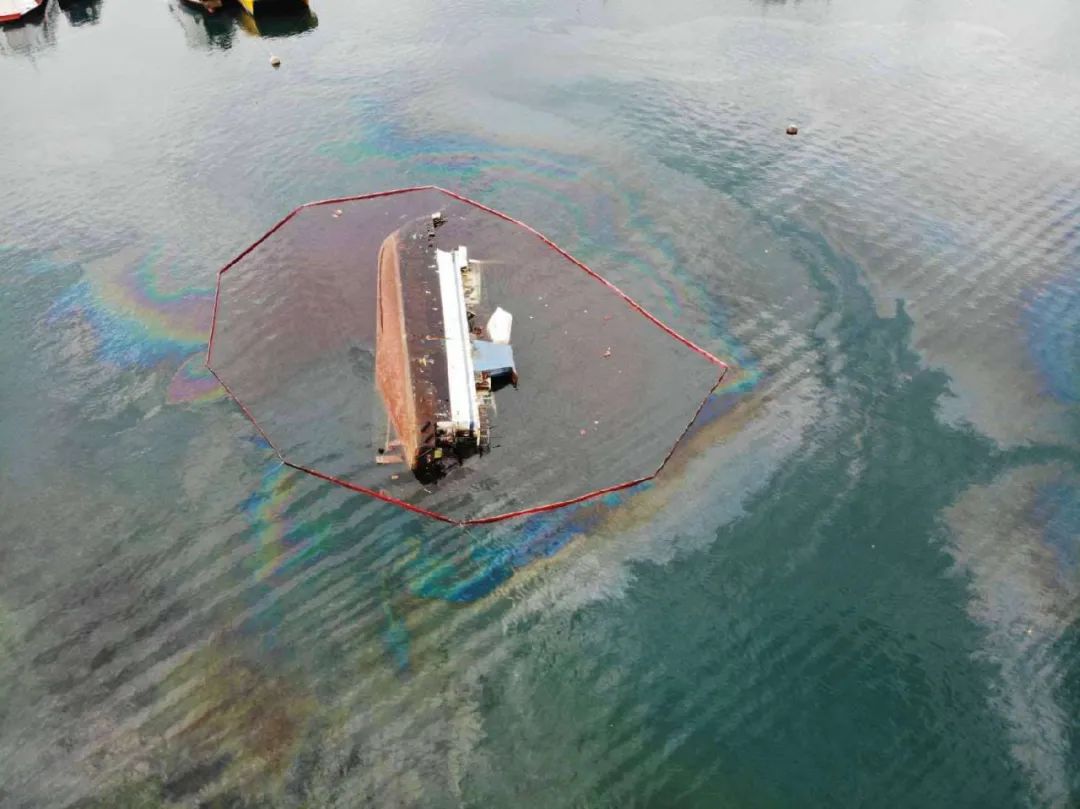
Image Credit: Internet
图源网络
The shipowner shifted the blame to the management department
In response to the accident, the managing director of the ship's company made a strong statement to Fiji Broadcasting Corporation (FBC) on June 3. He clearly denied any involvement of his company in the accident: "Call the (Transport) Minister or the CEO of Fiji Ports. I'll stop my statement here. No comment, it's their responsibility. We are innocent, and our hands are clean." When asked whether there were any technical problems, he reiterated that all issues should be referred to the Fiji Ministry of Transport and Fiji Ports Corporation.
船东撇清责任,矛头指向管理部门
针对此次事故,该船所属公司董事总经理于6月3日向斐济广播公司(FBC)作出强硬表态。他明确否认事故与该公司有关:"打电话给(交通)部长或斐济港口首席执行官,我的发言到此为止。不予置评,这是他们的责任。我们是清白的,我们的手是干净的。" 当被问及是否存在技术问题时,他重申所有问题应转交斐济交通部及斐济港口合作公司。
The competent authority remains silent as the investigation has been launched
As of the time of the report, FijiPorts Ltd has not responded to the inquiries, and the Fiji Maritime Safety Authority, responsible for shipping safety supervision, has declined further comment. Ro Filipe Tuisawau, Fiji's Minister for Infrastructure and Meteorology, only confirmed that the matter was “under investigation” without disclosing any specific details.
The report pointed out that the ship had been moored at the dock since 2019 and had been used as a garbage dump during that time. There is no further information on whether the Fiji authorities will conduct an investigation into this accident, what measures will be taken to mitigate the pollution impact, or when the sunken ship will be salvaged or removed.
The roll-on roll-off ship accident in Suva Port, Fiji, is still developing, and the diesel pollution caused by it has posed a threat to the local water ecology. However, the investigation of the accident responsible party is still ongoing. Similarly, similar shipping accidents have occurred in the global shipping field recently. On June 8, a tugboat accident occurred in the Siberian region of Russia, which also drew widespread attention.
主管部门沉默 调查已启动
截至报道时,斐济港口合作有限公司尚未回应质询,负责航运安全监管的斐济海事安全局(Maritime Safety Authority)则拒绝进一步置评。斐济基础设施和气象部长若•费利佩•图伊萨沃(Ro Filipe Tuisawau)仅证实“此事正在调查中”,未披露具体细节。
报道指出,该船自2019年起便一直系泊在该码头,期间曾被用作垃圾堆放场。关于斐济当局是否会就此事故展开调查、将采取何种措施减轻污染影响、以及何时打捞或移除沉船,目前尚无进一步消息。
在南太平洋斐济苏瓦港的滚装船事故仍在持续发酵,其引发的柴油污染已对当地水域生态造成威胁,而事故责任方的调查尚无定论。无独有偶,全球航运领域近期类似的船舶事故时有发生,俄罗斯西伯利亚地区也发生了一起内河船舶事故,同样引发广泛关注。
Tugboat struck an unknown object and sank in the Yenisei River, Russia
On the evening of June 8, a tugboat with a length of 51.5 meters and a deadweight tonnage of 197 tons (IMO: 8995184) was pushing two empty barges downstream when it struck an unknown underwater object, resulting in hull damage. According to the accident report, the vessel's stern was severely damaged and lost control, taking on water. Although it was urgently beached, the stern compartment continued to be submerged, eventually leading to partial sinking of the vessel. All 14 crew members on board were rescued at the time of the accident, with no casualties reported. Russian authorities confirmed that the accident caused oil pollution and have urgently deployed oil booms and oil absorption felts and other anti-pollution barriers to control the spread. The specific information of the underwater object that caused the accident has not yet been announced, and relevant institutions have launched a formal investigation into the cause of the accident.
俄罗斯叶尼塞河一拖轮触不明物体后沉没
无独有偶,6月8日晚间,俄罗斯西伯利亚叶尼塞河卡扎钦斯基急流(Kazachinsky rapids)河段发生一起船舶事故。总长51.5米、载重吨197吨的(IMO:8995184)在推送两艘空载驳船下行时,撞击不明水下物体导致船体受损。据事故通报,该轮艉部遭受严重破坏并失控进水,虽紧急抢滩搁浅,但艉舱仍持续淹没,最终造成船舶部分沉没。事发时船上14名船员全部获救,无人员伤亡报告。俄罗斯当局确认事故引发油污泄漏,已紧急布设围油栏和吸油毡等防污染屏障控制扩散。目前尚未公布肇事水下物体的具体信息,相关机构已就事故原因展开正式调查。
Suva Port, located in the South Pacific, plays a pivotal role in the shipping map of Fiji. As the core seaport of the Republic of Fiji and a shipping hub in the South Pacific, Suva Port is known as the "crossroads of the South Pacific." Its every move attracts global shipping attention. The recent capsizing accident of the roll-on roll-off ship not only affects port operations but also poses a threat to local waterways' ecology. The investigation into the accident responsible party is still in progress. This incident also draws our attention to Suva Port again and helps us gain a deeper understanding of its significant role in the shipping field and the challenges it faces.
在南太平洋的航运版图中,斐济苏瓦港占据着举足轻重的地位。作为斐济共和国的核心海港与南太平洋地区的航运枢纽,苏瓦港向来有南太平洋“十字路口”之称,其一举一动都备受全球航运界瞩目。近期发生的滚装船倾覆事故,不仅对港口运营产生影响,更给当地水域生态带来威胁,而事故责任方的调查仍在进行中。这一事件也让我们将目光再次聚焦于苏瓦港,深入了解其在航运领域的重要角色与面临的挑战。
Suva Port
苏瓦港
Geographical Location and Climate Features of Suva Port
Suva Port is located on the southeast coast of Viti Island in Fiji (the full name is the Republic of Fiji). Situated on the east side of Suva Bay's entrance, it is east of Tonga and west of Vanuatu. As Fiji's largest seaport and a shipping center in the South Pacific, Suva Port is renowned as the "crossroads of the South Pacific."
From the perspective of surrounding ports, it is 590 nautical miles west of Port Vila, Vanuatu; 730 nautical miles from Noumea, New Caledonia; 1,211 nautical miles from Honiara, Solomon Islands; 1,911 nautical miles from Port Moresby; 1,740 nautical miles southwest of Sydney, Australia; 1,140 nautical miles south of Auckland, New Zealand; 644 nautical miles east of Apia, Western Samoa; and 2,780 nautical miles northeast of Honolulu, USA.
The port falls under a tropical rainforest climate. The annual average temperature ranges from 24℃ to 30℃. It is frequently hit by tropical hurricanes, with an average annual rainfall of about 3,000 mm. The average tidal range is 0.8m.
地理位置与气候特征
苏瓦港是位于斐济(全称:斐济共和国THE REPUBLIC OF FIJI)的维提(VITI)岛东南沿海的港口。苏瓦港在苏瓦湾东岸的入口处,东邻汤加(TONGA),西邻瓦努阿图(VANUATU),是斐济的最大海港,又是南太平洋的航运中心,有南太平洋的“十字路口”之称。
从周边港口来看,苏瓦港西距瓦努阿图维拉港590海里,距新喀里多尼亚努阿美港730海里,距所罗门群岛霍尼亚拉港1211海里,距莫尔兹比港1911海里,西南距澳大利亚的悉尼港1740海里,南距新西兰奥克兰港1140海里,东距西萨莫亚阿皮亚港644海里,东北距美国夏威夷的火努鲁鲁2780海里。
该港属热带雨林气候。年平均气温在24~30℃左右。常受热带飓风袭击。全年平均降雨量约3000mm。平均潮差为0.8m。
Historical Background
Fiji became a British colony in 1874 and declared independence in October 1970, becoming a member of the Commonwealth. Suva, as the capital, serves as the nation's political, economic, and transportation center, and Suva Port has developed accordingly.
Once a coal supply station for the British Navy, Suva Port played a strategic role during World War II as a vital logistics base for the U.S. military, which significantly advanced its port facilities and related services.
历史背景
斐济早在1874年成为英国殖民地,1970年10月宣布独立,成为英联邦成员国,苏瓦作为首都,是全国政治、经济和交通中心,苏瓦港也随之不断发展。
苏瓦港曾是英国海军的煤炭供应站,二战期间,因战略地位重要,成为美军重要的后勤补给基地,这对其港口设施和相关服务的发展起到了推动作用。
Port Facilities
港口设施
There are coral reefs outside the port as a barrier, and the water inside the port is deep and calm, making it a natural harbor. There are 3 main berths in the port area, with a coastline of 678m and a water depth of 12.1m. The loading and unloading equipment includes shore cranes, movable cranes, forklifts and roll-on/roll-off facilities, as well as oil pipelines with a diameter of 203.2mm for loading and unloading oil. The terminal can handle ships with a maximum deadweight of 50,000 tons, and can load and unload bulk, roll-on/roll-off and containers. The water depth of the large ship anchorage is 36m. Nearly a thousand ocean-going cargo ships from various countries are received every year.
The port has a wharf extending from southwest to northeast, facing northwest, with a total length of 495 meters, and a front water depth of 10.6-11.0 meters below the chart datum. There are 3 berths, the middle berth is used for sugar export, the south berth is used for refueling ships crossing the ocean, and the north berth is used for vegetable oil export; there is also a berth of 183 meters long and a front water depth of 9.5 on the north end of the wharf, which is used for loading and unloading groceries, and container ships can also dock here. There are also some shallow water berths. The significance of this port can also be seen from the setting of the port wharf.
First, it is a terminal in the South Pacific, which plays an important role in refueling ships. Secondly, the country's economic pillar is sugar, and the export of sugar determines the country's trade level.
Warehouse equipment: The port is equipped with various warehouses, among which the cold storage can provide refrigeration services for exported beef cattle, fish, etc. There are also sugar factories and corresponding sugar import equipment, bulk grain loading and unloading equipment, cement warehouses, oil and gasoline storage tanks, etc.
Communication and navigation: Suva Port is well-equipped with communication equipment and can provide a variety of communication services, such as sfax, tel, telex, etc. Navigation facilities include lighthouses, radio beacons, etc., which provide protection for ships entering and leaving the port and sailing.
The main export goods are sugar, coconut oil, timber and syrup, etc., and the main import goods are grain, fuel oil, machinery and chemical products. Most of the shipping companies operating South Pacific Shipping Company are affiliated to Suva Port, such as Bank/Columbus, ACTA, Pacific Plaza, Sovrana, Reef (REEF) and other shipping companies, and they do not operate during holidays.
港口外有珊瑚礁作屏障,港内水深,风平浪静,是一个天然良港。港区主要码头泊位有3个,岸线长678m,水深12.1m。装卸设备有岸吊、可移式吊、叉车及滚装设施等,还有直径为203.2mm的输油管供装卸石油使用。码头最大可靠5万载重吨的船舶,散装、滚装及集装箱均可装卸。大船锚地水深达36m。每年接待各国远洋货轮近千艘。
港口有一西南-东北向伸展的码头,朝向西北,总长495米,前沿水深在海图基准面以下10.6-11.0米,有3个泊位,中间泊位用于糖出口,南泊位为横渡大洋船只供油用,北泊位用于植物油出口;码头北端瓦鲁努湾岸还有长183米、前沿水深9.5的泊位,用于装卸杂货,集装箱船也可停靠于此。还有一些浅水泊位。从港口码头设置也可知本港的意义,一是南太平洋中的航站,起着为船只加油的重要地位,其次该国的经济支柱是糖,糖的出口决定该国的贸易水平。
仓库设备:港口配备各类仓库,其中冷藏库能为出口的肉牛、鱼肉等提供冷藏服务,还设有制糖厂及相应的进糖设备、散粮装卸设备、水泥仓库、石油及汽油储存罐等。
通信导航:苏瓦港的通信设备齐全,能提供多种通信服务,如sfax、tel、telex等,导航设施包括灯塔、无线电信标等,为船舶进出港和航行提供保障。
主要出口货物为糖、椰油、木材及糖浆等,进口货物主要有粮食、燃料油、机器及化工产品等。经营南太平洋航运公司的船公司大多挂靠苏瓦港,如班克/哥伦布、ACTA、太平洋广场、索夫兰纳、里夫(REEF)等航运公司、在节假日中均不作业。
Port Management
Suva Port is managed by the Fiji Ports Authority, located 3.5 km northeast of the port. It provides essential services and support to ensure smooth port operations.
As Fiji's "gateway" port, Suva Port plays a key role in the country's economy, trade, and tourism and is a critical node in the South Pacific shipping network.
港务管理
苏瓦港由斐济港务局负责管理,港务局位于苏瓦港东北部,距离港口约3.5公里。港务局为港口的运营提供各种服务和支持,确保港口的正常运转。
苏瓦港作为斐济的“门户”港口,不仅在经济、贸易和旅游方面发挥着重要作用,还在南太平洋地区的航运网络中占据着关键地位。
E-PORTS offers comprehensive services at Suva Port, with key services including captain procurement, crew change, cargo handling, port charges settlement, and spare parts. For more details on Suva Port's policies and fee forecasts, contact:
WhatsApp/WeChat: 13816101982
Email: contact@e-ports.com
E-PORTS为苏瓦港提供全面服务,重点业务包括船长采购、换员、装卸货物、港使费结算、备件等。如需了解更多苏瓦港详细港口政策及费用预测,可通过以下方式联系:
WhatsApp/WeChat:13816101982
Email:contact@e - ports.com
 RELATED NEWS
 Hotline
 Email
Email

 沪公网安备 31011502016705号
Disclaimer:
This communication has been prepared for general information only. To the maximum extent permitted by law, E-PORTS and its affiliated companies, its and their employees, directors, agents, contractors (of any tier) and partners shall not be liable for any loss, claim, charge, damage, liability or damages howsoever arising in connection with the information even if advised of the possibility of damages. The use of the information shall be at your sole risk. Information contained herein comes with no representation or warranty (express or implied) and specifically is not represented or warranted to be correct, complete, accurate or up to date. The information is provided on an “as is” and “as available” basis and is not intended to be relied upon in any way. You shall be solely responsible for the selection, use, efficiency and suitability of the information.






 Chat with us