
Key Clauses for Ship-owners to Review in Charter-parties after Implementation of the Revised Maritime Law: 8 Items for Re-examination 新海商法实施后,船东签租船合同最该注意什么?8个条款重新检查
The newly-revised Maritime Code of the People’s Republic of China entered into force on 1 May 2026.
For ship-owners, apart from reviewing statutory provisions themselves, a more practical concern lies in identifying risks that should be explicitly documented in voyage charter-parties for future contracting and performance.
Under the revised Maritime Code, voyage charter-parties have been moved from the original chapter “Contracts of Carriage of Goods by Sea” to Chapter 6 “Charter-parties”, alongside time charter-parties and bareboat charter-parties, forming a standalone legal regime for charter-parties.
Article 127 clearly stipulates that charter-parties cover voyage, time and bareboat charters and shall be concluded in written form. Article 128 provides that statutory provisions governing rights and obligations of lessors and lessees under this chapter apply principally where the charter-party contains no relevant agreement or divergent provisions. Article 129 further adds that where terms of a voyage charter-party are ambiguous, relevant provisions under Chapter 4 governing parties’ rights and obligations may apply in supplement to voyage-charter rules.
Read together, these articles signal a material shift. In 2026, ship-owners must look beyond statutory rules and focus closely on how charter-party wording is drafted. In particular, clear drafting of clauses covering laytime, NOR, demurrage, despatch and exceptions can materially determine final cost settlement outcomes.
2026年5月1日起,新修订的《中华人民共和国海商法》正式施行。
对船东来说,这次修法值得盯的不只是法条本身,更关键的问题是:以后签和执行航次租船合同时,哪些风险得提前写进合同里?
新《海商法》把航次租船合同从原来的“海上货物运输合同”章节挪到了第六章 “租船合同”,跟定期租船合同、光船租赁合同放在一起,形成了独立的租船合同制度。
第127条写得很清楚,租船合同包括航次租船、定期租船和光船租赁,并且要求采用书面形式订立。第128条规定,本章关于出租人和承租人权利义务的条款,原则上在租船合同没有约定或者没有不同约定时才适用;第129条又补了一句,航次租船合同约定不明的,除了适用航次租船的规定,还可以适用第四章有关当事人权利义务的规定。
这两条放在一起,指向一个很实际的变化:2026 年船东要面对的,已经不只是“法律怎么规定”,而是“租船合同到底怎么写”。尤其是装卸时间、NOR、滞期费、速遣费还有各种除外事项,条款写得清不清楚,可能直接决定最后费用怎么结算。

What Core Changes Are Introduced by the Revised Maritime Law?
Previously, provisions for voyage charter-parties were located in Chapter 4 “Contracts of Carriage of Goods by Sea”. Following the legislative revision, voyage-charter rules are relocated to Section 2 of Chapter 6 “Charter-parties”, building an independent charter-party legal system together with time-charter and bareboat-charter provisions.
This re-organization is more than a simple chapter-number adjustment. It further affirms the commercial-contract nature of voyage charter-parties and grants contracting parties greater flexibility to define mutual rights and obligations by contractual agreement.
Article 128 merits ship-owners’ particular attention: contractual stipulations shall prevail for rights and obligations under charter-parties. Meanwhile, Article 129 retains supplementary application of Chapter 4 provisions where a voyage charter-party lacks or contains ambiguous relevant terms.
For ship-owners, the practical take-away for 2026 can be summarized as follows: statute law supplies baseline rules, whereas the charter-party governs most operational details. Put differently, charter-party negotiation carries greater weight than before.
新《海商法》到底改了什么?
以前,航次租船合同的相关规定主要在《海商法》第四章“海上货物运输合同”里。新法实施后,航次租船合同被调整到第六章“租船合同”第二节,跟定期租船、光船租赁一起,构成了独立的租船合同体系。
这个调整不是简单换个章节号。它进一步明确了航次租船作为商事合同的独立性,也给了当事人更大的空间去通过合同安排双方的权利义务。
船东最该关注的是第 128 条:租船合同里的权利义务,原则上优先按双方合同约定来。而航次租船合同如果相关权利义务没约定或者约定不明,新法第129条仍然保留了适用第四章规定的补充机制。
所以对船东来说,2026年的租船合同可以这么理解:法律给底层规则,合同决定大量具体操作。
换句话说,租约谈判的分量更重了。
- Calculation of Laytime
This is one of the highest-priority clauses for ship-owners to revisit.
Article 134 of the revised Maritime Law specifies that laytime for loading and discharging, laytime calculation methodologies, demurrage for excess time and despatch for time saved shall be agreed between contracting parties.
Two concepts deserve close scrutiny: duration and calculation methodology.
A charter-party cannot rely merely on brief wording such as “LOAD 4 DAYS / DISCHARGE 5 DAYS”. Parties should explicitly define:
- The point of laytime commencement
- The point of laytime termination
- Circumstances triggering laytime suspension
- Time periods eligible for exclusion from laytime
- Treatment of port waiting time
- Treatment of shifting-time expenses
- Handling of weather-related disruptions
- Allocation of delays arising from cargo characteristics
- Laytime computation after entering demurrage status
Disputes seldom centre purely on the number of allowed lay-days. Instead, most disagreements stem from ambiguities over how those days are computed.
第一,装卸时间怎么算?
这是船东最该重新过一遍的条款。
新《海商法》第134条写得很明确:航次租船合同的装货、卸货期限及其计算办法,超过期限后的滞期费和提前完成的速遣费,由双方约定。
这里有两个词不能放过:“期限”和“计算办法”。
也就是说,租约不能只写一句“LOAD 4 DAYS / DISCHARGE 5 DAYS”就完事。真正得写清楚的是:
- 什么时候开始算?
- 什么时候结束?
- 什么情况下暂停?
- 什么时间可以扣除?
- 港口等待算不算?
- 移泊时间算不算?
- 天气影响怎么处理?
- 货物本身造成的延误谁承担?
- 进入 DEMURRAGE 以后怎么算?
真正容易扯皮的,往往不是“几天”,而是“这几天到底怎么算”。
- Submission of NOR Does Not Automatically Trigger Laytime Commencement
The Notice of Readiness (NOR) constitutes a critical procedural element for voyage-charter performance.
Ship-owners should carefully verify contractual provisions addressing:
- Valid locations for NOR submission
- Permissible timing for NOR tendering
- Full readiness conditions that the vessel must satisfy upon NOR tender
- Laytime treatment in the event of failed hold inspection
GENCON 2022 contains noteworthy refinements compared with its predecessor. According to official BIMCO documentation, GENCON 2022 represents a comprehensive rewrite of the voyage-charter standard form, with enhanced granularity for NOR, hold inspection, laytime and demurrage mechanisms. BIMCO confirms GENCON 2022 as its current flagship and widely-adopted standard form for dry-bulk voyage charters globally.
Accordingly, ship-owners should avoid the assumption that “NOR delivery equals immediate laytime start”. Laytime activation depends on whether NOR has been validly tendered per charter-party requirements and whether the vessel meets contractual readiness conditions.
第二,NOR递交不等于LAYTIME自动开始
NOR(Notice of Readiness,准备就绪通知书)是航次租船实际执行里非常关键的一环。
船东要重点核对的是:
- 什么地点可以递交 NOR?
- 什么时候可以递交?
- 递交时船舶是不是必须满足全部ready条件?
- 如果验舱没通过,LAYTIME怎么算?
这也是GENCON 2022比旧版本更值得细看的地方之一。
BIMCO官方介绍显示,GENCON 2022 对航次租船合同做了全面重写,进一步细化了准备就绪通知、验舱、装卸时间、滞期费等合同机制。BIMCO同时明确,GENCON 2022是目前最新版本的GENCON,也是全球干散货领域广泛使用的航次租船合同范本。
所以船东别简单以为“NOR 发出去 = 开始算时间”。真正要看的是:NOR有没有按租约约定有效递交,以及船舶当时有没有满足合同规定的ready条件。
- Allocation of Time Losses Arising from Failed Hold Inspection
Hold inspection issues are frequently underestimated in day-to-day ship operations.
Even after vessel arrival and NOR tender, a failed hold inspection may trigger a sequence of events: hold re-cleaning, re-application for inspection, waiting for survey attendance and delayed loading commencement.
Whether such elapsed hours count towards laytime cannot be answered generically. Outcomes hinge on precise charter-party wording, root causes of the incident and supporting evidence.
For this reason, when reviewing charter-parties in 2026, ship-owners should look beyond demurrage rates and examine the full time-sequence chain: NOR → vessel readiness → hold inspection → commencement of loading / discharging.
第三,验舱失败,时间损失算谁的?
验舱是很多船东实际运营中容易低估的问题。
船到了港,NOR也递了,但货舱要是没通过验舱,后面可能就是一串:重新清舱 → 再次申请验舱 → 等检验 → 重新开始装货。
这些时间到底算不算LAYTIME?
没法用一个固定答案打发。最终还是得看租约具体怎么约定,以及当时实际发生的原因和证据。
这也是为什么2026年船东审租约时,不能只盯着“DEMURRAGE RATE”,而应该把“NOR → 船舶ready → 验舱 → 装卸开始”这条时间链连起来看。
- Which Port-caused Delays Should Count towards Laytime?
Upon port arrival, vessels may encounter multiple sources of waiting time, including berth availability delays, shifting operations, port congestion, cargo-handling-equipment breakdowns, adverse weather, insufficient cargo readiness, port-procedure hold-ups, documentary delays, governmental or customs interventions and revised terminal working schedules.
The core contractual question concerns the party bearing associated time-related costs.
GENCON 2022 delivers more detailed laytime rules, containing dedicated provisions for shifting-time scenarios, delays originating from cargo-related factors and waiting-for-documents periods after loading completion.
During charter-party negotiations, apart from confirming total allowed laytime (e.g. 96 or 120 hours), ship-owners should explicitly clarify liability allocation for real-world port disruptions.
第四,哪些港口延误可以算进LAYTIME?
真正进了港,船可能遇到一大堆等待:等泊、移泊、港口拥堵、装卸设备故障、天气影响、货物准备不足、港口手续等待、单证等待、海关或政府要求、码头作业安排变化。
问题是:这些时间到底谁承担?
GENCON 2022对装卸时间计算做了更细的安排,对部分特定情况下的移泊、货物本身原因导致的延误,以及装货完成后等待相关文件等情况都有专门处理。
所以谈租约时,除了问“LAYTIME是96小时还是120 小时”,还要多问一句:“如果港口现场真出了这些情况,这几个小时最后算谁的?”
- Commencement of Demurrage
During charter-party talks, many ship-owners focus heavily on the daily demurrage rate, for instance USD 15,000/day versus USD 20,000/day.
From an operational perspective, however, the threshold triggering demurrage liability carries equal or greater importance. Every hour exceeding contractual laytime may generate direct financial exposure.
A robust charter-party should enable ship-owners to trace this complete logical chain: When does laytime commence? → Which periods qualify for exclusion? → When is allowed laytime fully exhausted? → When does demurrage formally start? → How is demurrage computed thereafter?
In essence, this forms an integrated chain linking time, liability and financial settlement.
第五,什么时候开始DEMURRAGE?
很多船东谈租约时最关心的是:DEMURRAGE RATE是多少?USD 15,000/day 还是USD 20,000/day?
但从经营角度看,更重要的其实是:什么时候开始进入 DEMURRAGE?
因为一旦超过合同约定的装卸时间,后面每个小时都可能直接变成钱。
所以一份靠谱的租船合同,至少得让船东能回答清楚这条链:
LAYTIME从什么时候开始?→ 哪些时间可以扣除?→ 什么时候用完LAYTIME?→ 什么时候正式进入DEMURRAGE?→ 进入DEMURRAGE后怎么继续算?
这本质上是一条完整的“时间 → 责任 → 费用”链条。
- Demurrage and Despatch: Look beyond Published Rates
Article 134 of the revised Maritime Law leaves detailed demurrage and despatch arrangements to party agreement. GENCON 2022 further provides comprehensive contractual frameworks for these mechanisms. BIMCO official materials note that GENCON 2022 systematically redesigns clauses governing demurrage, despatch and laytime calculation.
When reviewing charter-parties, ship-owners are advised to verify the following points:
Demurrage
- Applicable daily rate
- Trigger point for demurrage accrual
- Whether demurrage runs continuously
- Events qualifying for exclusion
- Application of exception clauses once demurrage has commenced
Despatch
- Whether despatch compensation is payable
- Basis for calculating saved time
- Applicable despatch rate
- Whether all saved laytime qualifies, or subject to special contractual qualifications
Rather than focusing solely on monetary rates, contracting parties should clarify under which factual scenarios such payments accrue.
第六,DEMURRAGE和DESPATCH不能只看费率
新《海商法》第134条明确把滞期费和速遣费的具体安排交给双方约定。 GENCON 2022则进一步提供了比较具体的合同机制。
BIMCO官方资料显示,GENCON 2022针对滞期费、速遣费以及装卸时间计算做了系统化设计。
因此船东审租约时,建议至少确认以下几点:
DEMURRAGE
- 费率多少?
- 什么时间开始计?
- 是否连续计算?
- 哪些事件可以排除?
- 已经进入滞期后,除外条款怎么适用?
DESPATCH
- 付不付速遣费?
- 按什么时间算?
- 费率多少?
- 是所有节省时间都算,还是有特别约定?
别只看“多少钱一天”,要看“什么时间能产生这笔钱”。
- Exceptions Do Not Automatically Suspend Laytime
This point frequently creates contractual misunderstandings.
Upon seeing listed exceptions such as strikes, bad weather, port congestion or government intervention, practitioners sometimes assume laytime automatically stops accruing.
Actual outcomes are more nuanced. Contract wording determines whether an event results in laytime exclusion, laytime suspension, continued demurrage accrual despite the event, limited-scope exceptions or purely financial-loss indemnities without laytime relief.
GENCON 2022 reorganizes and refines general exception clauses. Nevertheless, BIMCO standard wording must always be interpreted alongside other negotiated charter-party provisions.
The presence of an “Exception” clause does not guarantee that the ship-owner bears no time-related losses. The critical inquiry is: precisely what effect does this exception produce?
第七,免责不一定等于“时间停止”
这是租约里特别容易产生误解的一点。
很多人看到STRIKE、BAD WEATHER、PORT CONGESTION、GOVERNMENT INTERVENTION,就下意识觉得“这段时间不算”。
其实没这么简单。到底是“不计LAYTIME”、“暂停LAYTIME”、“进入DEMURRAGE后继续算”、“只有特定情况才免责”,还是“仅针对特定损失免责”,都得看具体条款。
GENCON 2022对一般除外事项做了重新整合和细化,但BIMCO的标准条款本身也需要结合具体租约中的其他约定来理解。
所以看到“Exception”三个字,不代表船东就一定不用承担时间损失。真正要问的是:这个Exception到底改变了什么?
- Documentation and Record-keeping
Robust record-keeping is often overlooked during vessel operations yet heavily influences final demurrage settlement.
Even highly detailed charter-party wording may give rise to disputes without complete, continuous and verifiable on-site documentation.
Ship-owners should maintain and preserve key records including: NOR, Statement of Facts (SOF), Time Sheet, cargo documentation, port logbooks and other materials evidencing vessel status and port operational timelines.
Simply put: charter-party terms define what time may be claimed, while on-site evidence determines whether such claims can be substantiated. Charter-party management should not end upon signature and seal.
第八,记录
这是船东实际运营中最容易忽略、但最后又最影响结算的一环。
租约规定得再清楚,现场要是没留下完整、连续、可核对的记录,后面算 DEMURRAGE时照样可能扯皮。
所以船东得关注这些文件:NOR、SOF(Statement of Facts)、Time Sheet、Cargo Documents、Port Log,以及其他能证明船舶实际状态和港口作业时间的材料。
说白了:租约决定“哪些时间可以算”,现场证据决定“这些时间能不能证明”。租约管理不能在签字盖章后就结束。
Why GENCON 2022 Matters More for Ship-owners in 2026
It should be noted that GENCON 2022 was not released in response to the revised PRC Maritime Law. BIMCO published GENCON 2022 in 2022 as its flagship voyage-charter form. Compared with GENCON 1994, this form represents a full rewrite intended to reflect decades-long shifts in shipping-industry regulation, commercial models and operational complexity.
Accordingly, ship-owners in 2026 should not simply migrate from older forms directly to GENCON 2022. Instead, they should perform line-by-line comparisons between their existing charter-party templates, GENCON 2022 and provisions of the revised Maritime Law.
Below is a practical checklist for charter-party reviews: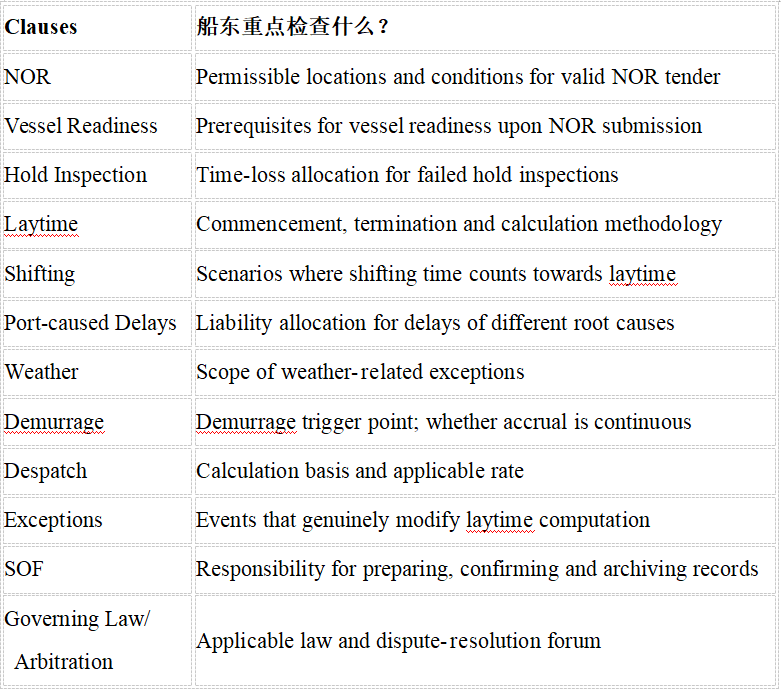
This checklist provides a practical reference for ship-owners re-examining charter-parties throughout 2026.
为什么2026年更值得关注GENCON 2022?
这里得特别说明一下:GENCON 2022不是因为新《海商法》实施才出现的。
BIMCO在2022年发布了GENCON 2022。BIMCO官方称其为目前最新版本的 GENCON,也是其旗舰航次租船合同;跟1994版比,新版本采取了更全面的重写方式,以适应过去几十年航运业在监管、商业模式和运营复杂度上的变化。
所以2026年船东真正该做的,不是“从旧合同切到 GENCON 2022 就完事了”,而是把自己现在用的租船合同,跟GENCON 2022以及新《海商法》的规则逐项对照。
这张表,才是2026年船东重新检查租约时真正值得拿出来的东西。
The Biggest Practical Change for 2026 Charter-parties
Reading the revised Maritime Law alongside GENCON 2022 reveals a clear industry trend: charter-party drafting has grown substantially more detailed.
Previously, stakeholders frequently turned first to statutory provisions. Today greater emphasis falls on what the charter-party explicitly states.
For voyage charters in particular, laytime, demurrage and despatch are heavily contract-driven. When concluding charter-parties, ship-owners should therefore look beyond negotiated freight rates and ensure contractual wording addresses high-risk real-world port scenarios.
To illustrate, for the same 12-hour port delay:
- Under Contract A, the charterer may bear the associated financial consequence;
- Under Contract B, part of the waiting period may count against allowed laytime;
- Under Contract C, exception clauses may preclude demurrage accrual entirely.
Such a 12-hour window can materially affect final ship-owner earnings.
2026 年租船合同最大的变化是什么?
把新《海商法》和GENCON 2022放在一起看,能看到一个很清楚的趋势:租船合同正在变得越来越细。
以前很多问题可能会问“法律规定是什么”,现在更该问“我的合同怎么写”。
尤其是航次租船里,装卸时间、滞期费和速遣费本来就高度依赖合同约定。所以未来船东签租约时,真正值得关注的可能不只是运价谈了多少美元,还包括这份租约有没有把港口现场最容易出的风险写清楚。
因为同样发生 12 小时港口延误:
- A合同可能最后由承租人承担;
- B合同可能部分计入 LAYTIME;
- C合同可能因为除外条款而无法产生 DEMURRAGE。
最后影响船东收益的,可能就是这12个小时。
Practical Actions Ship-owners Can Take Now
- Audit existing charter-party templates
Pay special attention to templates derived from GENCON 1994 or legacy amended forms. Prioritise review of NOR, laytime, demurrage, despatch and exception clauses.
- Reverse-engineer past demurrage disputes against contractual wording
Rather than merely analyzing why certain demurrage claims remained unrecovered, identify contractual gaps that gave rise to those scenarios. Review past incidents including berth waiting, failed hold inspections, shifting operations, weather disruptions, port congestion, documentary hold-ups and cargo-handling-equipment malfunctions. Frequently the root cause is not the port event itself, but the absence of advance contractual definition.
- Integrate charter-party governance with port-call operations
Charter-party management extends past contract signature. Operators should maintain this end-to-end workflow:
Charter-party clauses → NOR tendering → vessel-readiness confirmation → port-call factual records → SOF / Time Sheet preparation → laytime computation → demurrage / despatch settlement → cost review
This workflow helps translate contractual entitlements into real-world recoverable benefits.
现在可以做什么?
- 先检查现有租约模板
尤其是还在用GENCON 1994,或者基于旧版合同长期改出来的模板。重点查:NOR、LAYTIME、DEMURRAGE、DESPATCH、EXCEPTIONS。
- 把过去发生过的滞期争议倒推回合同
别只问“这笔 DEMURRAGE 为什么没收回来”,更该问“当初合同为什么没把这个场景写清楚”。
把过去一年发生过的等泊、验舱、移泊、天气、港口拥堵、单证等待、装卸设备问题逐项复盘。很多时候,真正的问题不是港口发生了什么,而是合同有没有提前定义这种情况。
- 把租约管理和港口运营连起来
这是最重要的一步。租约不是签完就结束,真正执行过程中需要形成一条链:
租约条款 → NOR 递交 → 船舶状态确认 → 港口作业记录 → SOF / Time Sheet → LAYTIME 计算 → DEMURRAGE / DESPATCH 结算 → 费用审核
这样才能真正把合同里的权利变成实际收益。
The revised Maritime Code of the People’s Republic of China has been in force since 1 May 2026.
For ship-owners, the core take-away from this legislative revision is not merely the addition of new statutory articles, but the enhanced practical weight carried by charter-party wording itself.
Within voyage charter-parties, practical outcomes hinge on multiple elements: valid NOR tender requirements, laytime computation rules, eligible time exclusions, demurrage-trigger conditions, exception-clause effects and evidential standards for dispute resolution. Seemingly discrete contractual clauses can translate directly into operational costs.
When reassessing charter-parties in 2026, ship-owners may bear this principle in mind: Freight rates define the upper bound of revenue; charter-party clauses define risk boundaries; and every recorded hour in port ultimately determines whether contractual entitlements can be financially realized.
During live charter-party performance, mitigating unnecessary port waiting, preserving key documentation such as NOR and SOF, timely laytime and demurrage calculation, and tracking abnormal port occurrences become essential steps for ship-owners seeking to control demurrage exposure and stabilize vessel schedules.
新《海商法》已经于2026年5月1日起施行。
对船东来说,这次修法最值得关注的,不是简单多了多少条新规定,而是租船合同本身的分量更重了。
尤其是航次租船合同里的:NOR怎么递?LAYTIME怎么算?哪些时间扣除?什么时候进入DEMURRAGE?除外事项怎么处理?发生争议时怎么举证?这些看着只是合同里几个条款,最后都可能变成真实的运营成本。
所以2026年船东重新审视租船合同,可以记住一句话:
运价决定收入上限,租约条款决定风险边界,而港口现场的每一个小时,决定最终能不能把合同里的钱真正拿回来。
而当租约进入实际执行阶段,怎么减少非必要港口等待、做好NOR及SOF等关键单证留存、及时核算LAYTIME和DEMURRAGE,并对港口异常进行跟踪,就成了船东控制滞期风险、稳定船期的重要环节。
E-PORTS operates as a digital integrated global vessel port service platform, delivering comprehensive onshore support solutions for shipowners worldwide. Our core service scope includes customized vessel routing planning, contingency response plans for emergency port incidents. For further enquiries covering port operations, detailed regulatory interpretations, cost forecasting and other professional shipping support, contact us via the channels below:
We Chat / Whats App:+86 13816101982
E-mail:contact@e-ports.com
E-PORTS作为一家面向全球船舶在港服务的数字化综合服务平台,可为船东提供专业在港的全方位服务支持。支持为船东规划合理路线以及提供港口临时突发事件解决方案建议,如需了解更多港口业务、详细政策、信息及费用预测等,可通过以下方式联系:
We Chat / Whats App:+86 13816101982
E-mail:contact@e-ports.com
Disclaimer: All data, analysis and commentary contained in this article are compiled based on public official releases and industry research reports, provided solely for industry exchange and reference purposes. This content shall not be construed as investment advice or binding operational commitments. Global shipping markets are subject to volatile influencing factors including macroeconomic cycles, geopolitical shifts and meteorological conditions, which introduce inherent uncertainties. All carriers and traders are recommended to formulate operational decisions after cross-referencing their own fleet structure, risk tolerance thresholds and latest real-time market intelligence.
免责声明:本文所载数据及分析均基于公开信息和行业研究报告,仅供行业交流与参考,不构成任何投资建议或操作承诺。航运市场受宏观经济、地缘政治、天气变化等多重因素影响,存在不确定性。读者在制定具体经营决策时,应结合自身船队结构、风险承受能力及最新市场动态综合判断。
 RELATED NEWS
 Hotline
 Email
Email

 沪公网安备 31011502016705号
Disclaimer:
This communication has been prepared for general information only. To the maximum extent permitted by law, E-PORTS and its affiliated companies, its and their employees, directors, agents, contractors (of any tier) and partners shall not be liable for any loss, claim, charge, damage, liability or damages howsoever arising in connection with the information even if advised of the possibility of damages. The use of the information shall be at your sole risk. Information contained herein comes with no representation or warranty (express or implied) and specifically is not represented or warranted to be correct, complete, accurate or up to date. The information is provided on an “as is” and “as available” basis and is not intended to be relied upon in any way. You shall be solely responsible for the selection, use, efficiency and suitability of the information.







 Chat with us